Posts

Showing posts with the label history

Fort Verde State Historic Park: A Reminder of Arizona’s Indian Wars

Image
Commanding Officer’s Quarters Stand in the breezeway of a charming, 150-year-old home, complete with period furniture and decorations, and you’ll finally get a chance to cool off from the Arizona heat. But you’ll be chilled when you realize why there’s a fort standing in the middle of Arizona, hundreds of miles from the nearest border.  Fort Verde State Historic Park  is the remnant of a military outpost built during the final campaigns of the Indian Wars. Administration building As Anglo settlers began to pour into the fertile Verde Valley region, the U.S. Army was tasked with protecting them from raids by Yavapai and Western Apache people defending their ancestral land. So Camp Verde was set up in 1865, later becoming the permanent Fort Verde in 1871. Years of battles between U.S. troops and Yavapai and Apache fighters culminate...

Is St. James Really Buried in Santiago de Compostela, Spain?

Image
As you head down a curve of the busy San Pedro street, you catch your first view of the twin bell towers of the cathedral of Santiago de Compostela—and you catch your breath. Petite hatchbacks rattle across the cobblestone as your feet seem drawn farther down the path, although that might just be gravity pulling you downhill toward the old zone. You cinch up your backpack’s sternum strap for the final approach of this multiple-night pilgrimage. For not the first time on your Camino, you lose your sense of direction as you enter Santiago’s old town: granite flagstones at your feet, stone-and-graying-plaster houses on either side, and overcast skies above disorient you—yet your eyes eventually lock on to a spray-painted yellow arrow on the side of a building. Once you’re back on autopilot, you start to reflect on why you started this crazy, 70-mile-plus hike in the first place. Rúa de San Pedro, Santiago de Compostela Maybe you hiked from Sarria farther inland as a cheap and hea...

Here’s 3,000 Years of Spanish History in 3,000 Words

Image
You’ll be shocked at how much history is all around you the first time you visit Spain. Major roads follow the same routes the Romans first trailblazed; your hotel might operate out of a renovated luxury apartment block from the 1800s; and soaring cathedrals still stand today based on 800-year-old technology. It can be overwhelming if, like me, you grew up in suburban America, where the oldest building dated back to the 1950s and Native American heritage was either scant or ignored. Coming to terms with the sweep of your country’s history is a lot easier when it’s only been around for a few centuries…versus a few millennia. True to my history major roots, I’ve extensively studied the history of Spain, reading several books and visiting as many cathedrals, castles, and museums as I could in the three years I lived in Spain. In this post, I’ve distilled 3,000 years of history down to around 3,000 words, saving you from having to read a 500-page textbook before you travel or move to...

Chasing Charlemagne in Aachen, Germany

Image
As a history major, I’m not one to subscribe to the Great Man theory of history. The way I see it, inventions, movements, religions, diseases, trade, and geography play a much more crucial role in human events than mere single characters do. And besides, there have been many Great Women! Nevertheless, some people are more influential than others: think Muhammad, Christopher Columbus, or whoever invented air conditioning. Aachener Dom When it comes to European history specifically, Charlemagne stands as one of the most significant actors in shaping what we know today as Europe. Following the countless barbarian invasions that had left the western Roman Empire in disarray, Charlemagne (who was himself a “barbarian” Frank) brought the West back together under a single rule, promoted learning amid the ignorance of the Dark Ages, and conquered so much land that he became the father of both France and Germany. During my weekend jaunt to western Germany last year, I made a daytrip...

Spain’s Controversial Valley of the Fallen

Image
It’s hard to believe but it’s already been almost four years since I first left the States to teach English in Spain. After a sleepless trans-Atlantic flight , I caught my first glimpse of España  over the western coast of Galicia, in the northwest. Cities along the densely-populated Rías Baixas  glittered in the soft baby blueness of dawn—beneath thick clouds;  this is  Galicia we’re talking about, now—and it wasn’t long before the plane had passed over rolling hills and entered the meseta central , the high plains of central Spain. The entrance Ávila was next, still neatly enclosed by its medieval walls, but what caught my attention the most as we crossed over the Guadarrama mountain range was a striking monumental cross that seemed to emerge from a heap of granite boulders. This fleeting image would soon be replaced by the sprawl of metropolitan Madrid and the runways of the Barajas airport, but it was unmistakably the lightning rod of modern Spanish so...

Photo Post: Santiago de Compostela’s Palace of Archbishop Xelmírez

Image
The main hall Come to Santiago de Compostela in rainy northwest Spain and you’ll inevitably be drawn to the city’s alluring, sprawling cathedral . After all, as the supposed resting place of the Apostle St. James, the towering church draws hundreds of thousands of pilgrims every year who trek the Camino de Santiago on foot. But another fascinating site hides in plain sight, leaning up against the cathedral’s walls in the monumental Obradoiro square: the Pazo de Xelmírez . Although in the Galician language the word pazo  historically refers to a nobleman’s luxurious country house, in this case it simply means “palace,” as it continues to function as the official residence of the archbishop of Santiago. I cropped this photo so you can see it better in the bottom left

Living Like Popes in Avignon, France

Image
It was mid-February and my friend Melissa and I were not amused with how the Galician winter had been treating us. Dark skies and  rainy  nights kept us indoors most of the time, and because of high humidity, the cold temperatures were particularly bitter despite never dropping below freezing. Simply put, we needed to get out, and  sunny  southern France  seemed like a great place to escape from Santiago for a long weekend. View this post on Instagram Arrival in Avignon // Santiago de Compostela 🚅 Vigo 🚈 Porto ✈️ Marseille 🚄 Avignon. Safe to say it's been a long 24 hours but @lissakathryn and I made it in one piece to this charming mid-sized city in France's southern region of Provence. After sharing some amazing open-face cheesy sandwiches and a raspberry tart that was to DIE for, we peeked in to the Place du Palais where you can get amazing views of the 14th-century Papal Palace, the residence...

San Millán de la Cogolla, the Cradle of the Spanish Language

Image
Fall landscapes in rural Rioja When traveling, some people seek out the best beaches or tranquil getaways, while others (the so-called “foodies”) research their destination’s tastiest dishes and the best places to eat them at. For me at least, I plan a lot of my trips around UNESCO World Heritage Sites, as I’m a big fan of historical sites and national parks. This program, associated with the UN since 1972, has recognized some of the planet’s most significant cultural and natural monuments. Spain has 44 such sites, making the country home to the third-highest concentration of Patrimonio de la Humanidad in the world. Vaulted cloisters in Yuso During my weekend trip out east to Logroño to visit my friend Mike in December, I got the chance to explore the Spanish region of La Rioja’s sole World Heritage Site: the Suso and Yuso Monasteries, out in the village of San Millán de la Cogolla. Although little known outside of this small province, these two monasteries are a great p...

Covadonga and the Founding of the Spanish Nation

Image
Church of Santa María la Real de Covadonga There are some places in Spain that draw tourists from all over the world—Antoni Gaudí’s still-unfinished Sagrada Família church, the Moorish wonders of the Alhambra , or the Prado Museum in Madrid —but then there are sites that draw a much more local crowd, monuments like Zaragoza’s Pilar Basilica , the royal pantheons where medieval kings and queens are buried, or a monastery where the Spanish language was first written down. The Royal Site of Covadonga, hidden deep within the mountains of the Picos de Europa National Park, belongs to the latter group of destinations. A small, underwhelming collection of monuments, Covadonga holds a special place in the Spanish national psyche for being the place where Spain was born. What happened here? The strategically-located cave The year was 722. Eleven years earlier, Muslim Berbers from North Africa had invaded the Iberian peninsula, quickly overrunning the feeble Kingdom of the Visi...

A Guided Tour Inside & Around the Cathedral of Santiago de Compostela, Spain

Image
Take away the cathedral of Santiago de Compostela, and the city—both past and present—would literally fall apart. Santiago, the capital of Spain’s northwestern region of Galicia, was founded on the belief that the relics of the Apostle James the Greater were discovered in the year 820 in this lonely outpost of Christian Spain—back when the Muslim Caliphate of Córdoba dominated the peninsula. Over the centuries, devotion to St. James grew and grew, causing millions of Catholics to set off from all corners of Europe and hike on foot to Galicia: the Camino de Santiago or “Way of St. James.” The passageway leading into Praza do Obradoiro The cathedral we can see today is actually the third such church to occupy the purported burial ground of St. James. Constructed in the austere Romanesque style between 1075 and 1211, grand Gothic cloisters were later built to the south and an over-the-top remodeling left almost no corner untouched during the Baroque era. There’s a lot going on her...

Photo Post: Remembering the Space Race in Houston, Texas

Image
Saturn V rocket A month ago I was back in Houston, Texas, for the weekend applying for a student visa at the Spanish consulate , which I need to go back to work in Spain as a language assistant for one more year. Because the Megabus schedules didn’t allow for me to leave Dallas early in the morning and return from Houston later in the day, I decided to make a city trip out of the whole ordeal and spend two nights in the local Hostelling International hostel. Third stage of the rocket I was first in line to apply for a visa at the consulate, so I ended up having more free time than I thought I would. Thankfully, I had brought my library’s copy of Alas Babylon  with me, so I spent several hours in Starbucks over the course of the trip engrossed in this highly realistic account of what might have happened had the U.S. and the USSR engaged in nuclear war. Written by Pat Frank, the book trailblazed the post-apocalypse genre and was published at the height of the Cold War in...

My 10 Favorite Churches in Rome

Image
When I was back home in Texas last summer, I decided to educate myself on all the architectural styles that have left their mark across the centuries in western Europe. I had a vague idea of what Romanesque , Gothic , or Classical Revival  buildings looked like, but I would have been stumped had you asked me to explain what exactly made each time period stand out from the others. So I embarked on  History of Architecture I ,  a free iTunes U course taught by Ohio State University professor Jacqueline Gargus. Although I have no background in architecture, engineering, or design, I found it super easy to jump right to Prof. Gargus’s lively discussion of western architecture. Ceiling of the Church of Santa Maria Maggiore Watching these lectures really helped me to grow in my knowledge of the major styles, and I now feel comfortable explaining the differences and revolutionary ideas of each era. I also enjoyed being introduced to some of the most significant exam...

They Speak More Than Just Spanish in Spain

Image
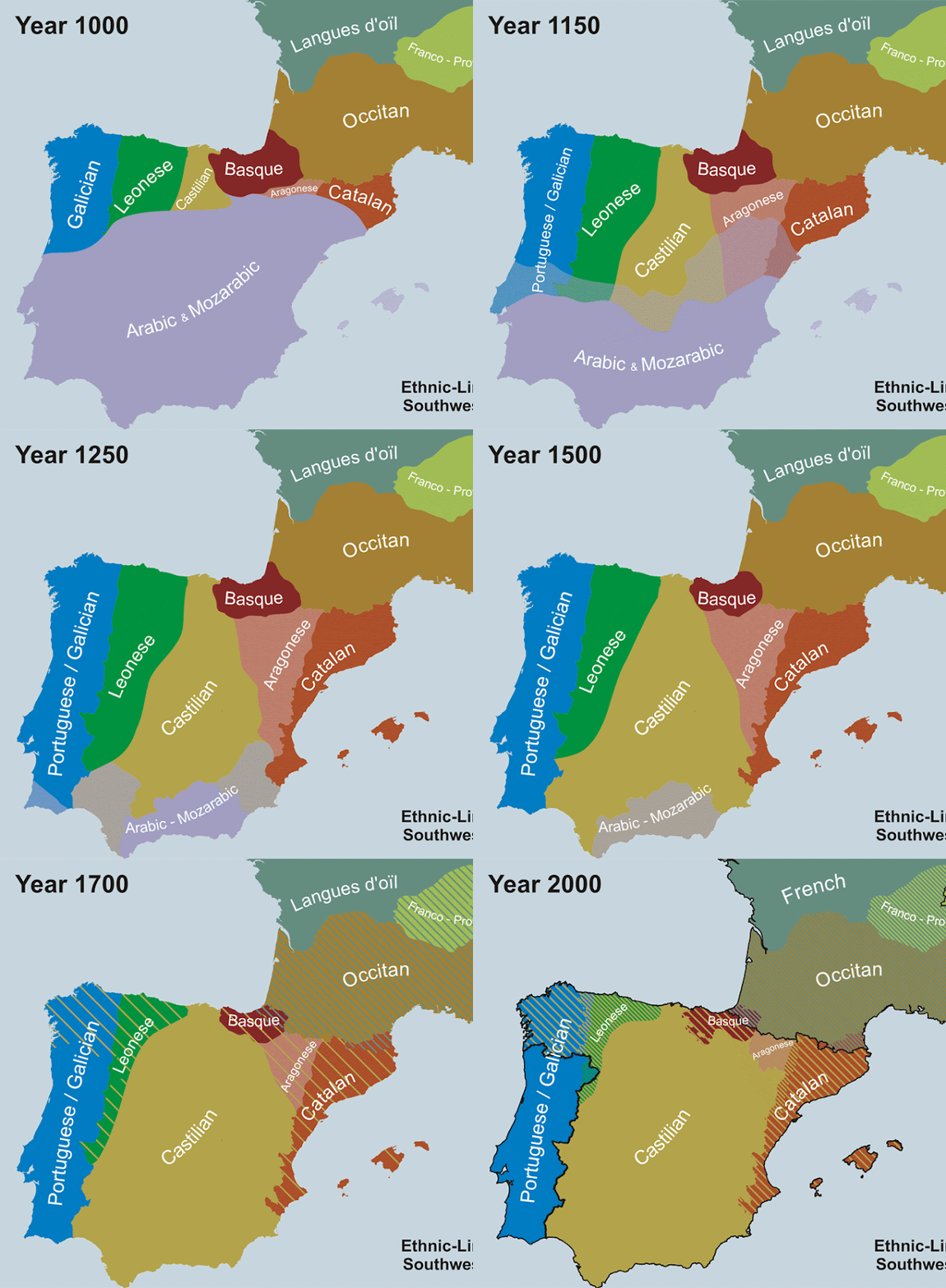
Did you know that they speak more than just Spanish in Spain? Did you know that there isn’t just one Spanish language, but perhaps eight Spanish languages? Until I started studying Spanish in college and came here for work, I had no idea myself. Spain is actually home to quite a few minority languages that make the country a more interesting place. It makes a lot more sense that the birthplace of español  could also be home to half a dozen other languages when you realize that Castilian Spanish began its life as the everyday Latin spoken around modern-day Burgos province in north-central Spain. During the Reconquista —a 700-year military struggle by the fledgling Christian kingdoms to the north to “re-”conquer the Muslim-ruled (and Arabic-speaking) lands to the south—Castilian emerged alongside Galician, Astur-Leonese, Aragonese, and Catalan, and as the conquerors pushed south into the Moorish states, they brought their respective languages with them. (Source: Wikipe...

Is It Blasphemy to Dislike Granada, Spain?

Image
(Disclaimer: I’m fully aware I’m about to step on approximately 11,920 toes with this post…) Patio de los Leones, the Alhambra Granada is… one of the biggest cities in the southern Spanish region of Andalucía home to the Alhambra, a beautiful Moorish palatial complex built in the Middle Ages during the last Muslim kingdom in Spain a center for generously large free tapas with your drink the burial place for the monarchs Ferdinand and Isabella a home base for going skiing in the snowy Sierra Nevada a great place to study abroad in the last city in Spain to be “re-conquered” from Muslim rule in the 1400s full of interesting neighborhoods like the winding, hillside Albaicín a popular place for the springtime Cruces de Mayo festival an essential stop for almost any trip to Spain Granada is nice and all, but… Tilework in the Alhambra Don’t get me wrong, the first time I visited Granada back in November of last year,  I loved  it. I...

3 Spanish Words for “Castle” That Come from Arabic

Image
If you spend any amount of time in the south of Spain, you’re bound to come across some castles that aren’t actually called castillos  in Spanish.  Instead, they’ve got some confusing name that begins with al- , like “ alcalá ,” “ alcazaba ,” and “ alcázar. ” Why not just stick with the native word for castle— castillo —and leave it at that? Well, during the Middle Ages, Arabic-speaking Muslims from North Africa ruled much of the Iberian Peninsula and countless Arabic words entered the Spanish language, words like algodón  (“cotton”), albañil  (“construction worker”), and aceituna  (“olive”). Alcazaba de Almería In addition to leaving a healthy amount of words in modern-day Spanish, the Arabic language also left lots of place-names across the country. Because of this, many castles you’ll run into around Spain will be called by their Arabic-derived term, usually because they are Moorish in origin or were built on an original Muslim fortification. Below ...

Toledo: Memorial to a Might-Have-Been Spain

Image
During an uncharacteristically-warm winter weekend in January I took a trip to Toledo in the heart of Spain. Yes, the same city that Toledo, Ohio, is named after (although in Spain it’s pronounced “toe-LAY-doe” [toˈle.ðo]). So what is Toledo all “about”? For me personally, it was almost like a peek into a pre-1492 Spain where Christians lived alongside Jews and Muslims. High on victory after completing the Reconquista that won “back” the peninsula from the Moors in 1492, King Ferdinand and Queen Isabella basically ordered everyone to convert to Catholicism…or get out. Many non-Christians chose the latter option, and within a hundred years Spain was one of the most Catholic countries anywhere. Toledo These actions weren’t without precedent in European history (England, for example, expelled its Jews in 1290) and weren’t the last act of intolerance, either, but they put the nation that would become Spain on a very clear mono-cultural path, rather than the mix of cultures that ha...

Bayeux, France: Home to a Story-Telling Tapestry

Image
After spending four days in Paris over Christmas, I was ready to leave the big city and experience life in the French countryside; lots of people I talked to before leaving for Christmas vacation told me that the provinces were just as good, if not better, than Paris. While planning for the trip, I didn’t really know what exactly there was  to see outside of Paris, but one thing I did know out there was the Bayeux Tapestry , viewable two hours northwest of Paris just off the coast of Normandy. I don’t think the tapestry would ever make it into Lonely Planet’s “Top Experiences” section, but since I’m a history major, I fully embraced my nerdiness and set off to see it. Bayeux Tapestry, scene 38 So what is this tapestry? Well, it’s a huge, 230-foot piece of linen fabric embroidered with scenes that depict the events leading up to the time when the Normans (invaders from Scandinavia who settled in northern France— Norman dy—and became French), led by Duke William, crossed t...