A travel and lifestyle blog about Arizona, Spain, and everywhere in between.
Mérida, Spain: Extremadura’s Living Reminder of Rome
Get link
Facebook
X
Pinterest
Email
Other Apps
In between moving out of Úbeda and going up north to hike the Camino de Santiago this June, I stopped off for two nights in Mérida, the capital city of the westerly Extremadura region. For the longest time, I had wanted to visit this town because of its well-preserved Roman ruins. After all, Mérida, or Emerita Augusta in Latin, was once the capital of the Lusitania imperial province that included most of modern-day Portugal as well as west-central Spain. Because of that status, it was bestowed with all the standard things you’d expect out of a Roman city: buildings like theaters, forums, arenas, and temples. Despite 2,000 years of history passing through the region, much of Mérida’s ruins are surprisingly still intact.
Train pass between the Los Milagros Aqueduct as they leave the train station going west. Although they aren’t nearly as impressive as, say, Segovia’s aqueduct, it’s still a reminder that Romans were able to bring fresh water from a lake 5km away into town every day.
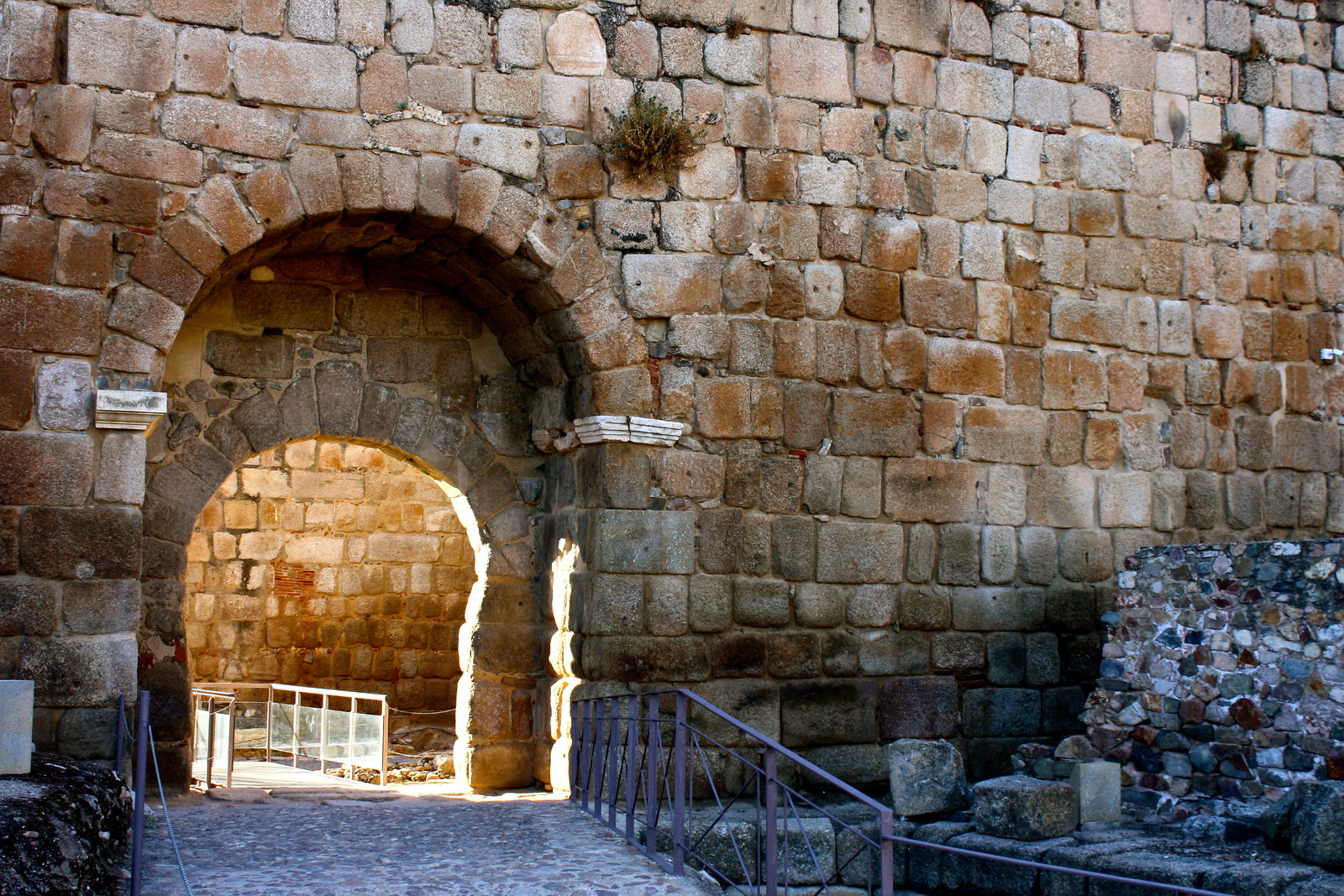
On a commanding position next to the Guadiana River sits Mérida’s Alcazaba, or Moorish-era citadel. It was the first such Moorish castle to be built in Spain, for not long after the Arab invasion of the Iberian Peninsula in 711, Mérida revolted against the new Moorish regime. In the early 9th century CE, these rebellions were put down and the emir Abd al-Rahman II ordered an alcazaba to be built along the river; the Roman wall was torn down and its stones were used to construct the castle. Although this fortress came long after the Romans had left, I’ve included it on this post because its construction material is directly linked to the city’s Roman past. If stones could talk, as they say, these guys would have an earful for us!
Think of the local Amphitheater as Spain’s miniature Colosseum. This arena would have seated 14,000 people for gladiator fights typical of the era. What I loved about this was that you could crawl all around the grounds, across the sandy field and into the spooky galleries. Obviously, much of the upper seating has vanished over the centuries, but it’s not that hard to envision wild, raucous crowds lining the elliptical structure.
This great Arch dedicated to Emperor Trajan would have been the entrance to the provincial forum, which would have been the administrative complex for the province of Lusitania.
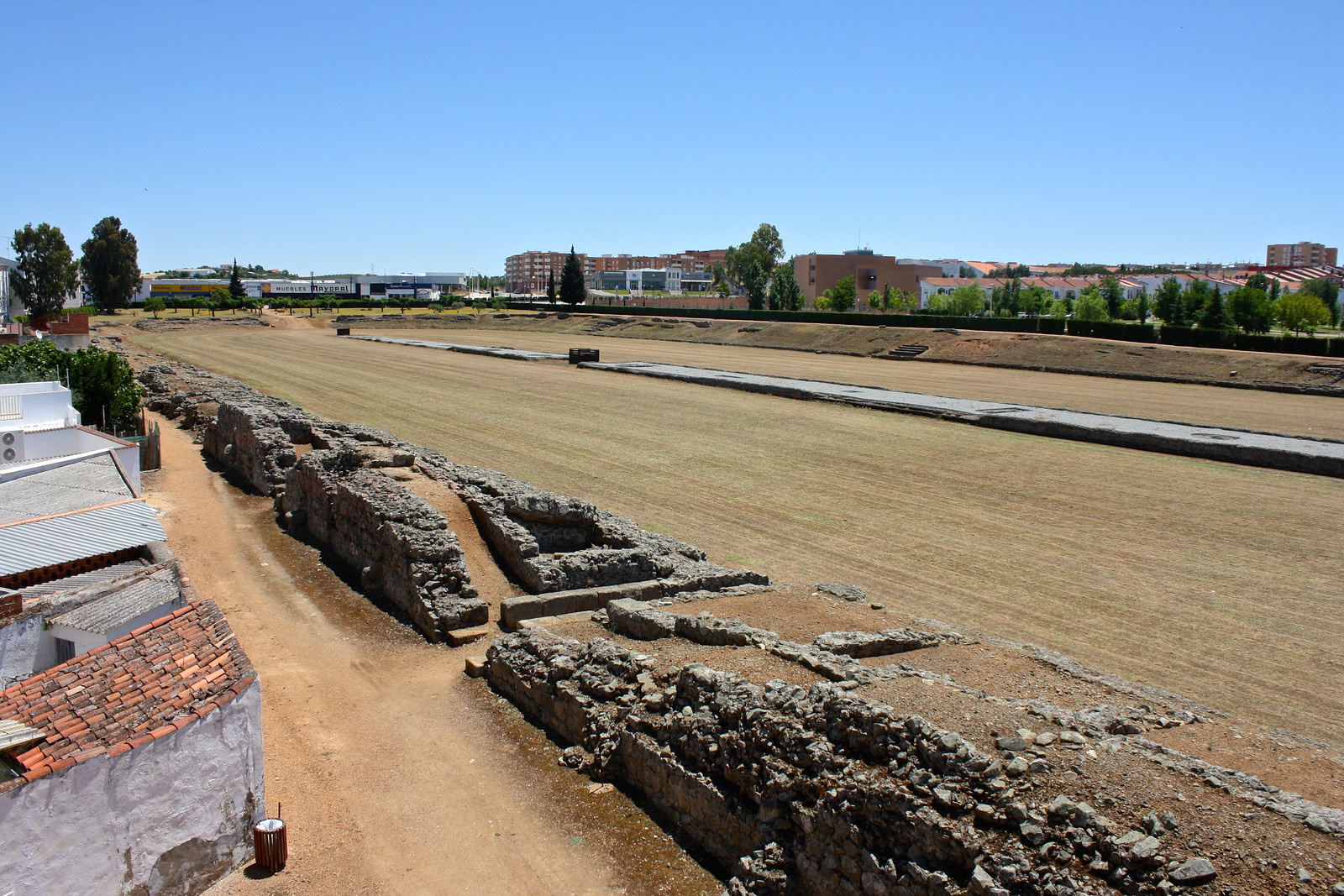
No, not that kind of circus, silly; think less Ringling Bros. and more NASCAR. In Roman times, this hippodrome would have been the site for Mérida’s chariot races. They probably were not as exciting as the Daytona 500, but if you’ve ever seen the movie Ben-Hur, they still would have been far from boring. The Roman Circus was built outside the ancient city walls, but even today it’s a good hike from the center of town. Although plain and relatively empty, it’s eerie to walk out onto the grassy track, climb up onto the spina or median, and be taken back twenty centuries to a boisterous horse-and-chariot competition.
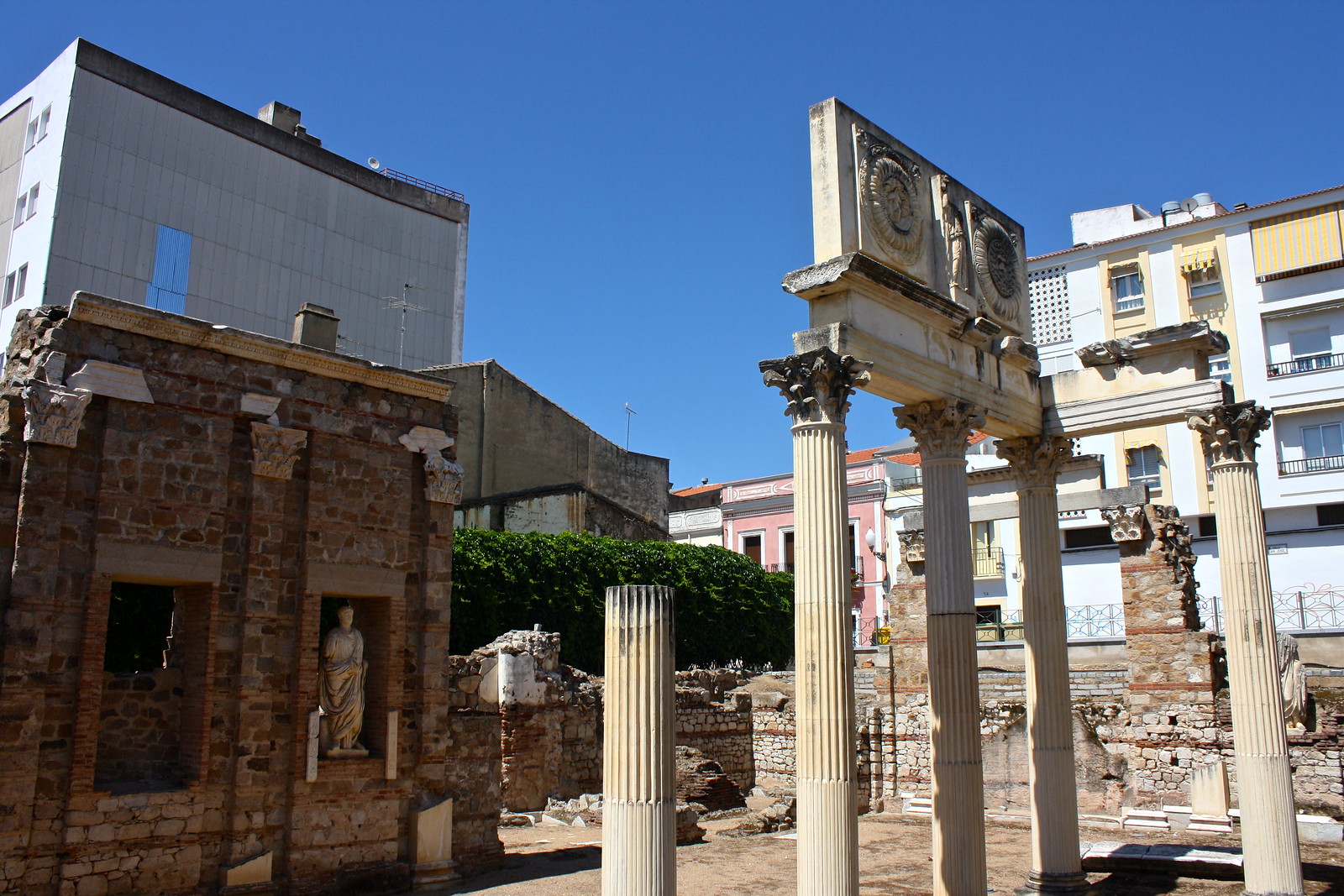
As Mérida was a provincial capital, it had not one, but two forums—a provincial one and a municipal one. The Arch of Trajan that I mentioned above would have led into the provincial forum, whereas the paltry remains of the Forum’s portico are a small cross-section of what would have surrounded the municipal forum. What we can see today is the corner of a long, colonnaded hallway that wrapped around a vast gathering space.
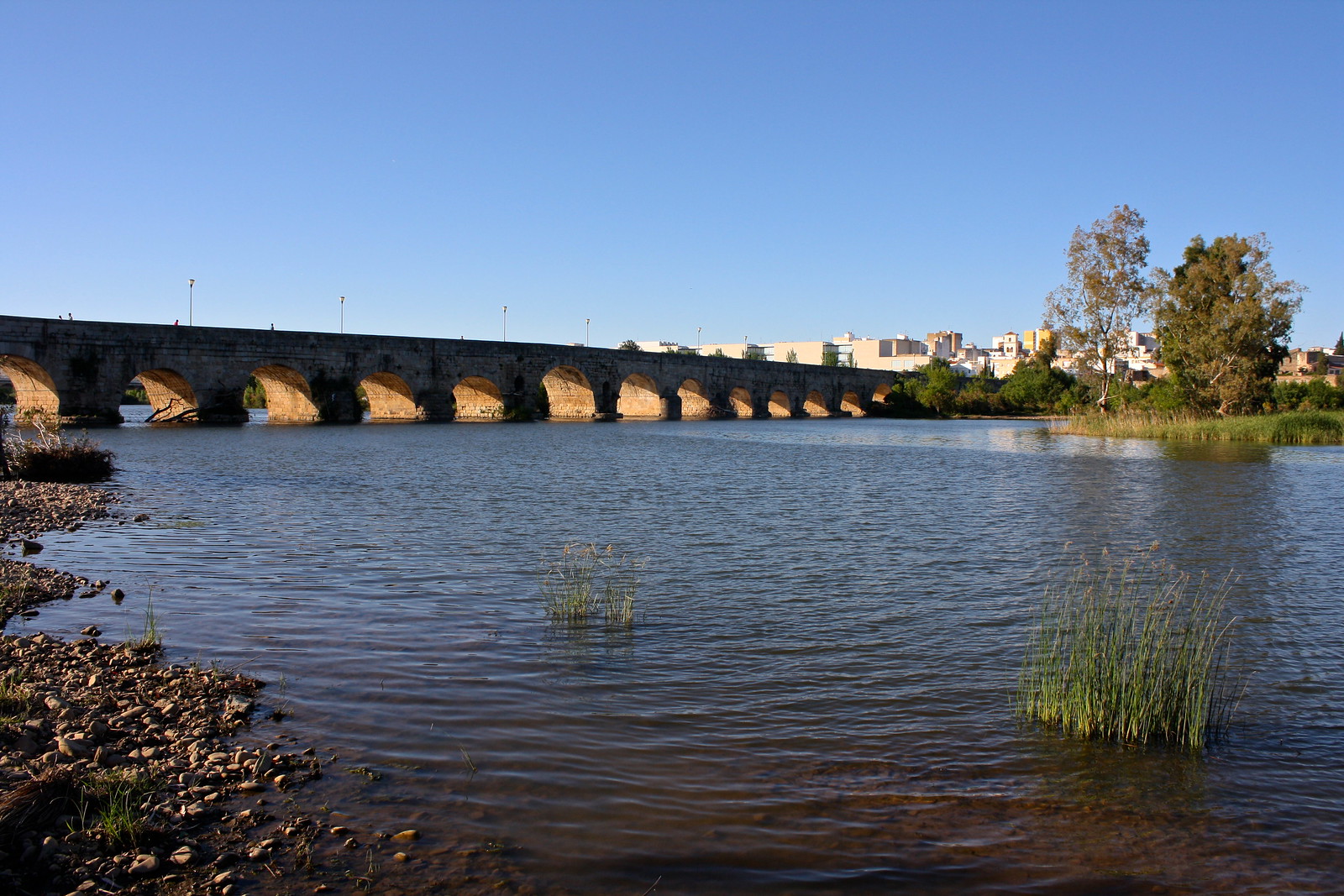
Everything else I’ve listed on this post pales when you compare them with the Roman Bridge. A half-mile long (!), it was the longest such bridge in Roman times and is still astounding today. It crosses the Guadiana River and lets you off at an island park via a ramp for a pitstop. A total of 60 arches link the original Roman settlement with the new town on the other side of the river.
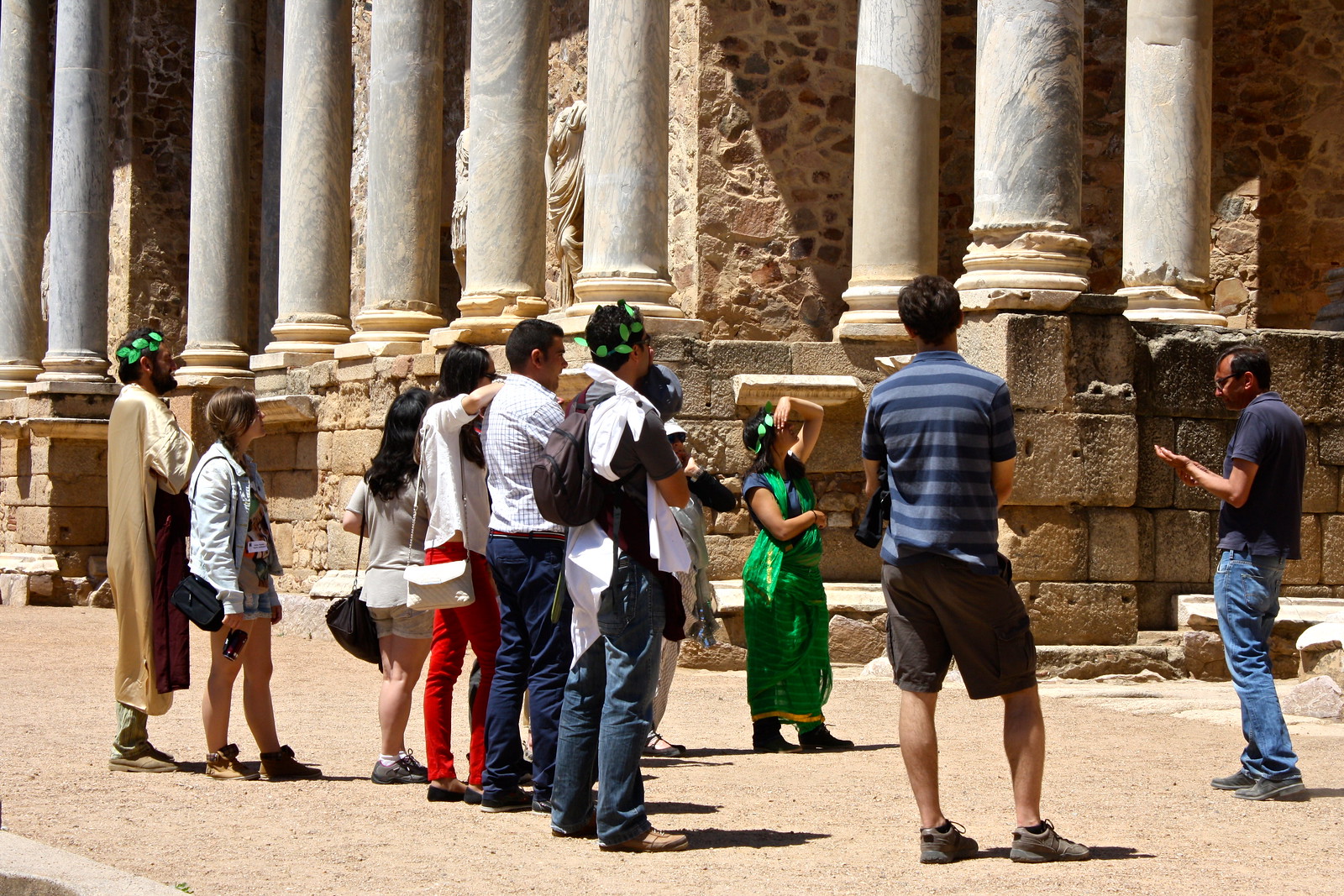
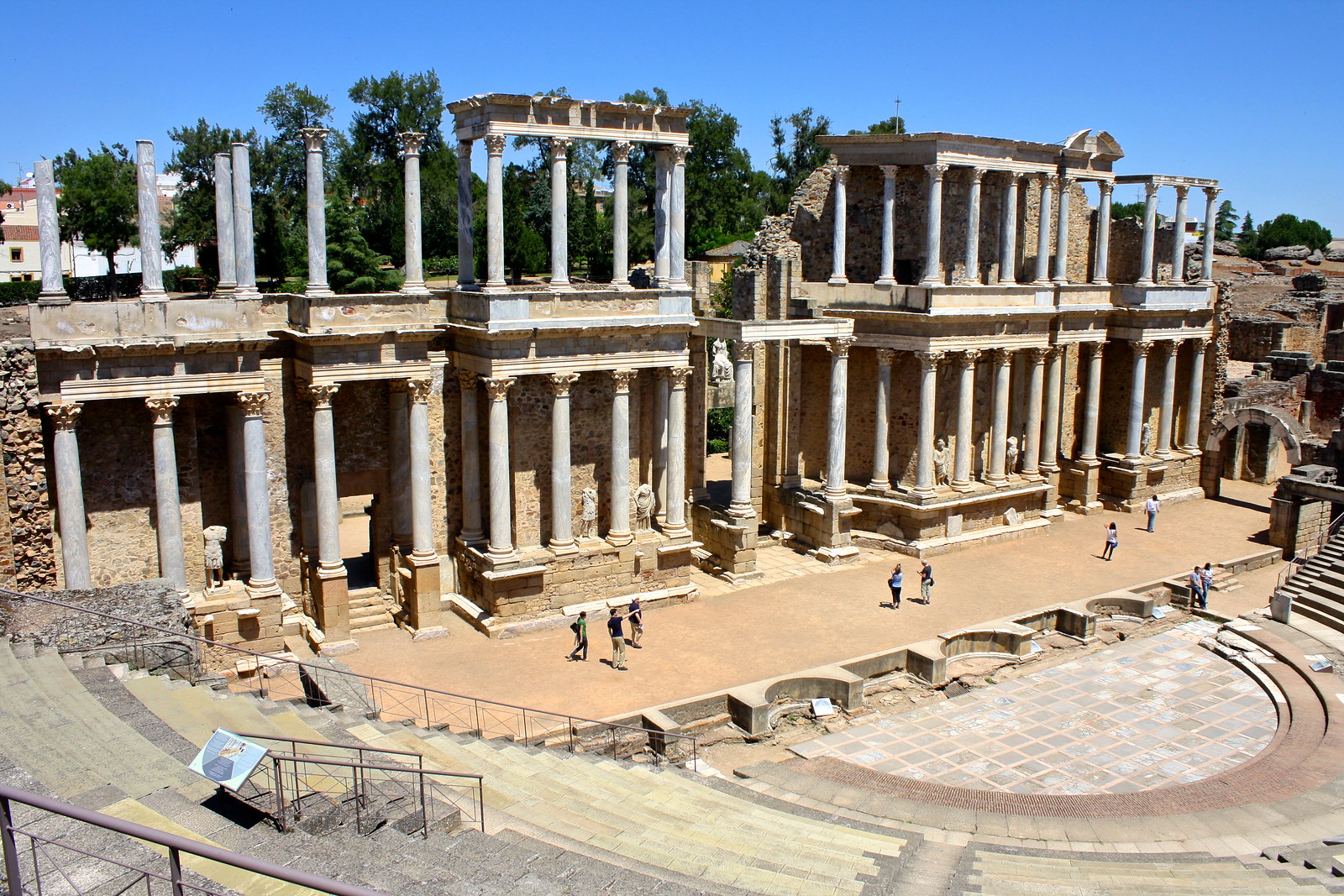
The star of the show is Mérida’s Roman Theater. While Greeks built their theaters into the sides of hills, the Romans constructed free-standing, walled semicircles, and Mérida’s was no different. It vies for attention with the neighboring amphitheater, but only the theater has been put back to use for its original purpose; every year a Classical Theater Festival is held in the (slightly-renovated) theatrum. It’s really remarkable that most of the original façade still stands today.
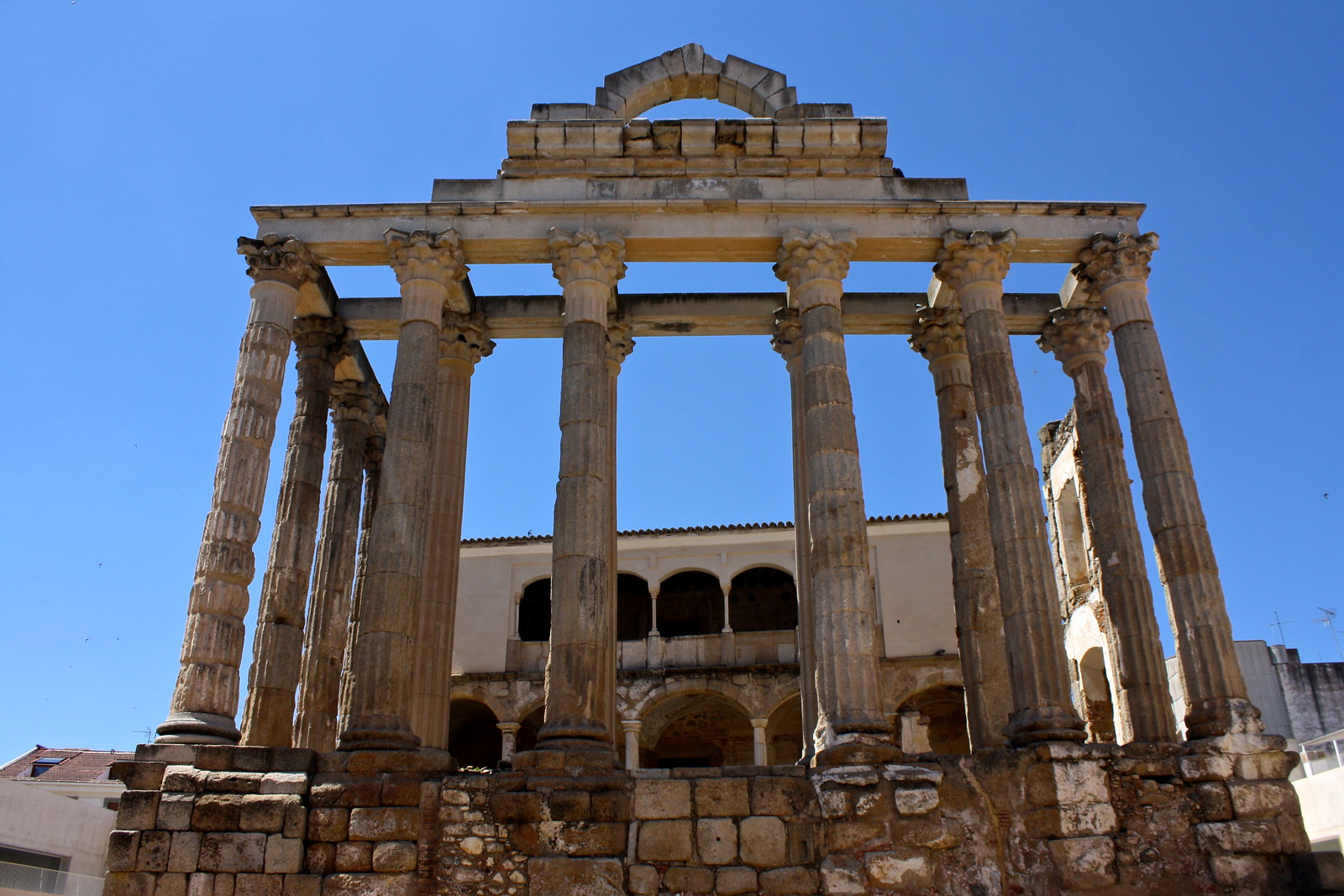
In the eastern side of the old town where the municipal forum would have been, you can find the Temple of Diana, although in reality it was probably dedicated to the imperial cult instead of the goddess Diana. Graceful Corinthian columns hold up a slender entablature and continue partway along the sides, where a Renaissance-era palace enters in. There’s not much to see, but some helpful plaques scattered around the temple grounds help give you an idea of what it was supposed to look like.
Just across the street from both the theater and the amphitheater is the National Museum of Roman Art, a massive brick structure that houses statues, mosaics, coins, and inscriptions that have been found from excavations done in town. Visiting Mérida felt much more complete after I explored the three levels of artifacts gathered from the city.
Have you ever been to Mérida before? What other cities outside of Rome offer well-preserved buildings like Mérida has? Comment below!
Northwest Spain holds so many treasures along its winding Atlantic coast, from big cities like A Coruña and Santiago de Compostela (okay, half an hour inland) to natural wonders like the Cíes Islands and the Ézaro waterfall . These are all fine and wonderful—I didn’t live and work in this part of Spain for two years for nothing!—but the further inland you go, the more cozy and comfortable Galicia gets. An important conversation La Galicia profunda —Deep Galicia, as locals call it—contains lush, old-growth forests and thriving vineyards, dying villages and the region’s third-largest city, oppressive summer heat and fondant layers of winter snow. It was here that hermits fled worldly pleasures for lives of isolation and prayer, yet here today that Carnival celebrations are their most colorful. Sometimes, on dark rainy evenings, you swear you caught a glimpse of the Santa Compaña , the procession of dead spirits passing through the woods. Ribadavia is one of many villages in...
Eighty-seven—that’s the number of Catholic cathedrals in Spain today. Although I didn’t grow up Catholic (I’m a Southern Baptist turned Episcopalian), this church nerd managed to visit 26 of Spain’s cathedrals that span a multitude of architectural styles and layouts when I lived in the country from 2012 to 2015. Why cathedrals? There’s nothing intrinsic about a cathedral that automatically makes them big and beautiful; they’re simply home to the cathedra or seat of a bishop. But from the Middle Ages onward, bishops enjoyed great social status, and the churches where they presided reflected this prestige with monumental works of architecture. (Fun fact: Barcelona’s soaring Sagrada Família is not a cathedral, as it is not the seat of the bishop of the diocese of Barcelona). With so many cathedrals to see in Spain, it’s hard to know what to focus on. Below I’ve composed a list of my top ten favorite ones, which includes crowd-favorites like the cathedral of Sevilla as well as of...
After Paris and the Bayeux Tapestry , the third thing I wanted to see while traveling in France was Mont-Saint-Michel , a towering monastery built on top of a mountainous island off the coast of Normandy. Before visiting, I really didn’t know much at all about the Mount except that it was only accessible when the tides were out…and that it looked just plain cool. During the visit, I ended up learning a bit about French history and why the Mount is such a big deal for the French people. Mont-Saint-Michel It was by sheer luck, though, that I was able to visit Mont-Saint-Michel at all (pronounced “mohn san mee-shehl” [mɔ̃ sɛ̃ mi.ʃɛl]). The very day I had chosen to visit Mont-Saint-Michel was the first day in weeks that the tourist bus was running between Saint-Malo (where my hostel was) and the Mount, with maybe one or two other runs more for December. I paid 20€ for the round-trip service but didn’t complain because this really freaky coincidence made the whole visit p...